


Artificial Intelligence
Fractional canny edge detection for biomedical applications
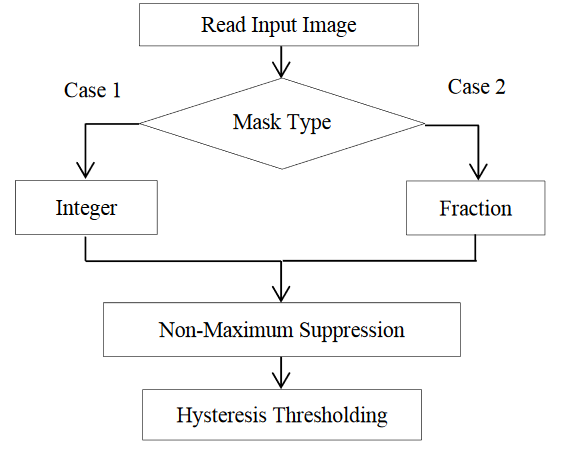
This paper presents a comparative study of edge detection algorithms based on integer and fractional order differentiation. A performance comparison of the two algorithms has been proposed. Then, a soft computing technique has been applied to both algorithms for better edge detection. From the simulations, it shows that better performance is obtained compared to the classical approach. The noise performances of those algorithms are analyzed upon the addition of random Gaussian noise, as well as the addition of salt and pepper noise. The performance has been compared to peak signal to noise
Improved Production Key Performance Indicators (KPI’s) Using Intelligent-Manufacturing Execution Systems (I-MES)
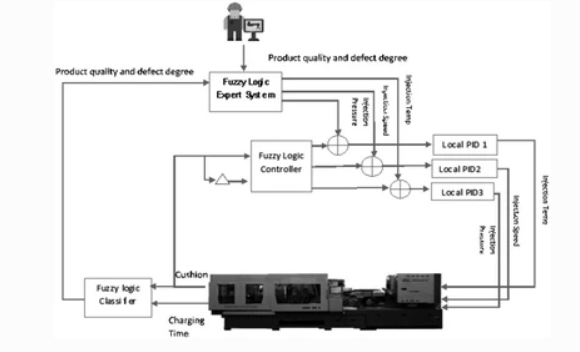
The aim of this research is to reduce the gap between manufacture expertise and management expertise by using modern technology like Manufacturing Execution System (MES) via Artificial Intelligence (AI) and Machin Learning (ML). A design of MES has been proposed and implemented on El-Araby Plastic Injection Molding (PIM) factory. This work is based on the International Society of Automation Standard (ISA-S95). A fully automated data management system has been designed and implemented to control data follow between shop floor e.g. (machines and operators) and management floor e.g. (production
Salinity stress reveals three types of RNA editing sites in mitochondrial Nad7 gene of wild barley both in silico and in qRT-PCR experiments
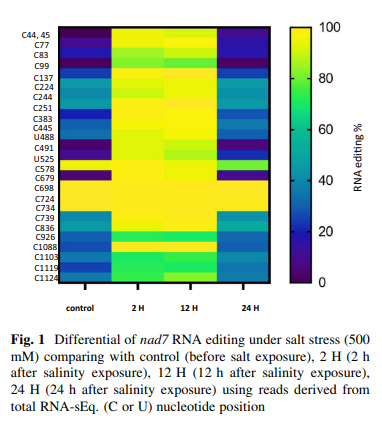
Cellular respiration is an important process performed by mitochondria. Nad complex is the major complex involved in this process and one of the main subunits in this complex is the nad7 (nad dehydrogenase subunit 7). In Hordeum vulgare subsp. spontaneum, four nad7 cDNAs are described at 500 mM salinity, 0 h, or control (GenBank accession no. MW433884), after 2 h (GenBank accession no. MW433885), after 12 h (GenBank accession no. MW433886) and after 24 h (GenBank accession no. MW433887). Twenty six RNA editing sites were revealed in positions: C44, C45, C77, C83, C99, C137, C224, C244, C251
Support for increased cardiovascular risk in non-segmental vitiligo among Egyptians: A hospital-based, case–control study
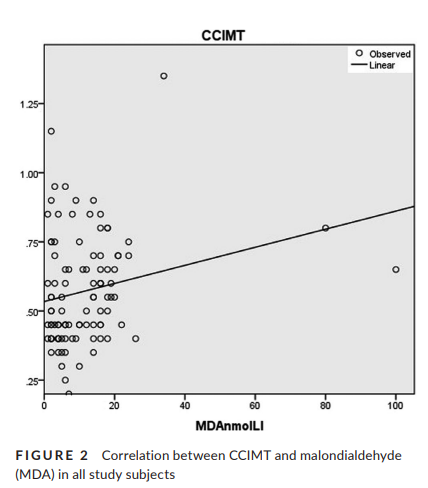
Background: Data have been accumulating in the past few years that identify vitiligo as a disorder with systemic implications. Results and methods: In this hospital-based, cross-sectional, case–control study, 50 patients with non-segmental vitiligo and 50 age- and sex-matched controls underwent analysis of serum lipid profile, oxidative stress biomarkers and carotid duplex. Hydrogen peroxide (H2O2) and malondialdehyde (MDA) were significantly higher in patients than controls (p-value <.001, <.001, respectively); on the other hand, total antioxidant capacity (TAC) was significantly lower in
Association between long noncoding RNA taurine-upregulated gene 1 and microRNA-377 in vitiligo
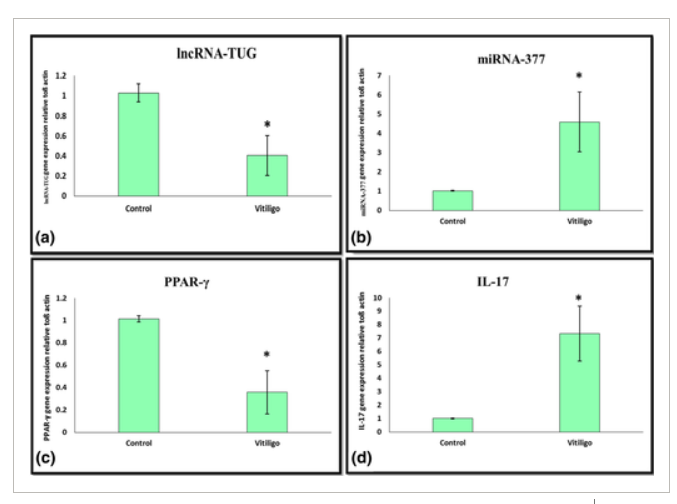
Background: Taurine-upregulated gene 1 (TUG1) is one of the long noncoding RNAs (lncRNAs) that plays a role in melanogenesis. MicroRNA-377 (miRNA-377) is a conserved noncoding RNA that regulates angiogenesis and promotes oxidative stress. Peroxisome proliferator-activated receptors (PPARs) are components of the nuclear hormone receptor superfamily. PPAR-γ activators stimulate melanogenesis. Interleukin (IL)-17 has been implicated in the pathogenesis of several immunological diseases. This work aimed at detecting the expression levels of lncRNA TUG1, miRNA-377, PPAR-γ, and IL-17 among vitiligo